Step out in excellence. Individuals and organizations mired in mediocrity failed to reach their potential, fall short of meeting customer expectations and do not achieve the best. Excellence demands dedication, creativity, innovation, cooperation and coordination between teams and departments. The analogy of the impact player works to explain the high bar necessary in today’s environment.
Impact players are peak performers, game changers and difference makers. They are recognized as the superstars in our organizations, schools, communities and families. They are the stars on the team, the leaders that people respect and emulate. The greater the number of impact player available, the more it accelerates and creates a critical mass necessary to reach your goals.
Organizations cannot afford wholesale mediocrity within their ranks. They must select the best talent, develop the best talent and retain the best talent. Just imagine how productive we would be if we increased the number of impact players within our group. They would realize that they are in need group of performers. Their presence would have a synergistic effect on the group. Employees would be more engaged and productive; students would achieve higher grades and test results. Businesses would consistently reach their productivity and financial targets.
There are 10 principles observed in impact players from academia, athletics, entertainment and business. This is not an exhaustive list and all of them may not be present in everyone.
Impact Player
A Natural Fitfor the Role
Excels in areas where their talents, skills and abilities are fully utilized
Powered by a Dream
Driven by ambitious and stretch goals to fulfill potential and purpose
A Student of the Game
Continuously learning information about their field and related areas
Fundamentally Sound
Masters the basics through practice and mental rehearsal
Sets High Standards
Fully engaged to beat their personal best, which exceed job requirements
Creative Expression
Develops new ways to improve work and play, with a style of their own
Passionate Execution
Aggressively implements plans and checklists to stay on tasks
Lead by Example
Personal actions match their words
Make Others Better
Elevates team performance by teaching and challenging the effort and results of peers
Serve Others
Willingness to share talent and resources – give back – pay forward
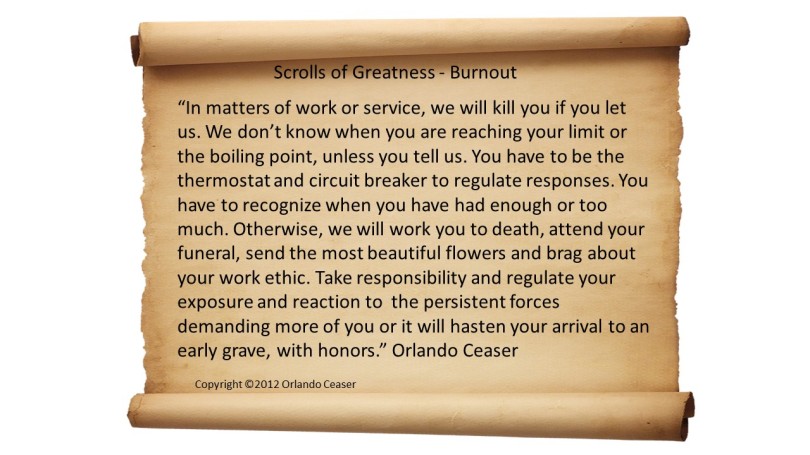
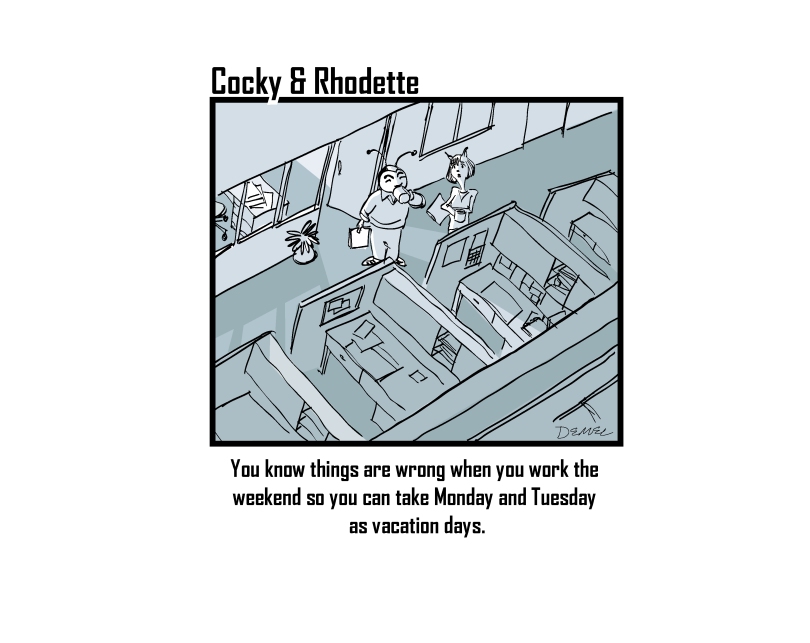
Burnout occurs when we try to do all things and be all things to all people. When we bite off more than we can chew and much more than we can digest. When we are running 100 miles an hour and need to reduce speed and take a rest, but we ignore the warning sign and keep going. Burnout occurs when we fail to acquire the skill to shape our lips and say No.
Burnout has three definitions that I would like for us to consider. The first two are from the Oxford dictionary.
the reduction of a fuel or substance to nothing through use or combustion.
the failure of an electrical device or component through overheating.
The third is from http://www.helpguide.org which defines burnout as “a state of emotional, physical, and mental exhaustion caused by excessive and prolonged stress. It occurs when you feel overwhelmed, emotionally drained, and unable to meet constant demands. … Eventually, you may feel like you have nothing more to give.”
Together these definitions describe a situation where an individual is physically and psychologically drained. This is not a desirable state in high performance individuals or organizations. We are more productive and more valuable to our company and families if we develop strategies to preserve our overall health.
I coined the phrase, “we will kill you if you let us.” This was spoken because I saw people with good intentions, deny their families, allow the workplace to encroach into their living rooms by failing to structure their time and priorities properly. They refused to delegate or ask for help when the workload was too high.
When the burden is great and before it is too late, we must slow down. Review the poem, Slow Down and make a list of tactics you will use to improve work/ life effectiveness. This is a phrase that many organizations use instead of work life balance, because they realize that balance may not be possible.
Slow down
How many signals do you need?
A mind is tired,
A body fatigued;
A heart is idling
At high speeds;
As you push harder
To succeed.
You’ve seen examples
Of careers,
That crashed and burned
In overdrive.
You’ve seen the sorrow
In your peers,
Who lived each day,
But never alive.
You better slow down
Before you go down
For the count.
You’re running red lights
And go to bed nights
With what amounts
To a weary heart.
How long have you seen
Warning signs?
How long have you been
Scorning signs?
You awake and
The morning lines,
Are unkind,
For you can’t unwind.
You better slow down
And get the low down
On your soul.
Don’t let the red zone
Lead to a headstone
On the goal.
How many signals do you need?
A mind is tired,
A body fatigued;
A heart is idling
At high speeds;
Create the balance
And succeed.
Courage is not the absence of fear but proceeding in its presence. Courage is not necessarily acts of bravery against a life-threatening adversary. Courage can be defined as a situation where you are prompted to rise, step forward and risk something, to benefit yourself or others. You must be willing to go to the front of the line to demonstrate bravery. Therefore, Courage is not always about us. It is performed as a practice, a template, a role model to benefit others.
There are instances during a day or a season when you are being watched by your family, group, team, peers and community. How will you respond in difficult situations? When a fear generating dilemma appears, there is a courage stimulating response that is required. How will you respond? Will you be brave?
When an intimidating moment appears in the leadership gauntlet, it is a perfect opportunity to stand up, show courage and be on the front line and take the lead with your people. What does courage look like? It varies with the demand and the scale of the crisis. Courage could mean standing up for them when they are bullied by peers, strangers or management. It could be when unfair assaults on their skills, reputation and performance occurs during a meeting or performance review. Courage could occur during periods of uncertainty when patience and guidance are needed to help someone make it through a frightening predicament.
Courage could also manifest itself in the ability to show weakness, vulnerability, empathy and compassion. Courage provides the opportunity to let down your guard and connect with people. Look for opportunities to show people that you are on their side, that you can identify with them and fight with them. You can roll up your sleeves, join the fight and work with them.
You must be awarethatfatigue it is one of the obstacles you will encountergoing through the leadership gauntlet.Self-healthwill strengthenyour mental physical and spiritual well-being. When we are fatigued, we cannot do our best work. We are not able to think clearly or created. I’ll run down feeling of low energy also reduces our productivity. A key component of is the amount of rest we receive. The sleep foundation says that “While sleep requirements vary slightly from person to person, most healthy adults need between 7 to 9 hours of sleep per night to function at their best. Children and teens need even more. And despite the notion that our sleep needs decrease with age, most older people still need at least 7 hours of sleep.” Are you getting enough sleep every night?
Secondly, we are surrounded by date to increase our awareness of nutritional foods and those products that may be good for us. The National Heart Lung and Blood Institute, NHLBI suggests that we have a healthy eating plan. “A healthy eating plan: Emphasizes vegetables, fruits, whole grains, and fat-free or low-fat dairy products. Includes lean meats, poultry, fish, beans, eggs, and nuts. Limits saturated and trans fats, sodium, and added sugars.”
In my book, the Isle of Knowledge I focus on the mantra that I use every day. I want to get my REPS in as a part of my normal routine. R stands for reflection. I begin each day thinking about the day and the activities that lie before me. E is for exercise. It may be simple calisthenics stretching or going to the club for more rigorous activity, such as lifting weights, running or participating in a spinning class. P is for prayer to ensure that I am spiritually centered. S is for study, which requires light reading to establish continuous learning. The study may be at the beginning of the day, during the day or at night before I go to bed.
You would agree with me that you do your best work when you are rested. Your ability to last and avoid fatigue is influenced by your eating habits, exercise routine and the amount of sleep you receive.
Pharmaceutical sales representatives are familiar with the customer referred to as the “Know-it-all doctor.” The connotation was not just a physician who knew everything, but an individual who was arrogant and spoke to people in a condescending manner. There was a feeling of superiority which made it difficult to deal with others. The air of arrogance made it hard to be effective as a leader. The person who knows everything and feels no one can teach them anything, is difficult to talk to and may not be open to receiving important information.
Many times, we use arrogance to cover-up for an insecurity. We don’t want people to recognize a deficiency in some aspect of our behavior and we do not wish to be challenged. On other occasions we do not wish to be questioned because we feel we are better than everyone. Humility is not a skill that makes them comfortable.
When you make the commitment to move beyond arrogance, it must be done with authenticity. Here is an example of what not to do. A manager received feedback that addressed his arrogance of feeling he was always right. It revealed that he did not listen to his direct reports, did not solicit their comments, but when they were given, he would not value or use them. It was described as follows.
He would adopt the stance of a good listener, someone concerned about his staff’s point of view. He would lean forward, establish direct eye contact and use transitional phrases such as, go on, is that so, I did not know that and tell me more. At the conclusion, he would thank them for their courage and valuable input. He would close by saying, he was glad to have the opportunity to know how they felt, but he would continue with his idea and the original plan. His subordinates were confused and wondered why ask for their opinions and bother going through such a pointless exercise. His actions curtailed their ideas and reduced trust. Why give comments if they did not matter?
Personalize your actions to prevent arrogant behavior by focusing on these areas.
Beware of arrogant tendencies.
Listen to others.
Involve others in your decision making
Include their ideas to show you value their suggestions
Do not respond in a threatening manner when you don’t like what you hear
People do not wish to support the arrogant person. They may withhold information. They may watch someone go down the wrong path and remain silent. They will surely not give them their best effort. They will do just enough to keep their jobs. They will engage in OMDB (Over My Dead Body) behavior and thinking. Review the poem below and reflect on it and discuss with others.
Many of us may be blind to our arrogant ways. In order to change we must be open to critical remarks without taking them personally. Act as if people may feel you are arrogant, and request insight. A manager read the poem below and was offended, for it struck a nerve. He was offended by the content because he thought I was speaking to him. However, members of his staff contacted me and confirmed that it was an accurate depiction of his arrogant leadership style. Let’s act as if this might be the case. Remove personal anxiety and allow people the opportunity to give you comments that are good for everyone.
How do you respond when things don’t go your way? When disappointment is your payment for living a good life, working hard and following the rules, how do you overcome? When the promotion you expected is postponed if not rejected and hope is difficult to manage, and your confidence in damaged, how do you proceed?
How do you pick up the pieces when expectations are shattered, everything that mattered in that moment is discarded, as your opinions are disregarded, how do you position yourself to win? This question and equivalent inquiries will challenge you, as we continue to live a life that makes a difference.
Cancer patients, who overcame adversity, and other people who are struggling with or have overcome against all odds, will tell you something similar. When they came out of the tunnel, life streamlined their purpose and they emerged from the funnel, after escaping from what seemed like hell, they grateful with being granted, a greater story to tell.
A story of victory, emerging from the fire, being at death’s door, but claiming success. They will tell you how they fought a hard fight and although fatigued, they pressed on for themselves and especially for those who were watching. They will tell you that faith and determination guided them, and although they had reservations, the truth that God would set them free became their reality.
When you feel you’re at the bottom of the well, you may be disappointed, your life may seem disjointed, but you are anointed. And when you feel you at the bottom of the well, keep climbing, for you will reach the top, with a greater story to tell.
A Greater Story to Tell
When you reflect on hurdles in the race;
The many times you stood after you fell.
When you think of dreams you’ve chased
And replaced
They give you a greater story to tell.
With struggles intense and continuous
Life buckled your knees, but your back was straight.
As children we were told that curiosity killed the cat, but our response was always, but satisfaction brought them back. On one hand we accused curious people of being nosy. However, curiosity was a good thing when you were called precocious. Curiosity is a critical characteristic to possess. Cultivating the habit of being curious is a precursor to creativity and innovation. Employees who constantly approach products and practices with a curiosity lens, are an asset to you, for they will develop ideas to improve your organization.
A corporate culture saturated with curiosity is vibrant and expanding. These individuals examine the status quo to understand its origins, as they look for ways to improve design and execution to increase overall quality. One of the tools of the curious is an enhanced ability to ask questions. They know that the right question will provide them with the information they need to understand and improve overall performance. Why have we always done process, this way? Many professions depend on the ability to ask questions; lawyers, salespeople, counselors, coaches, teachers, parents, years, psychiatrists and lawyers.
Curiosity paired with questioning skills will uncover information needed in an environment of continuous improvement. Think of ways that you could be more curious and set up a process to establish a curiosity infused workplace. Have fun with it because it will be exhilarating.
New leaders, in my day, were given 3 pieces of advice. These words were to guide us throughout our business careers. These words could also be a gauntlet for any leader. They have been known to demolish the morale in an organization and destroy someone’s reputation and career. We were told to never get involved in conversations regarding sex, politics and religion.
A new leader had many areas to grow and we did not need to be distracted by these very volatile topics. We can debate the relevance of this advice today, but I would like address one of the topics in a positive way. We frequently hear about the desire for employees want to bring their entire selves to work. We cannot deny that spirituality is important for many people.
Spirituality is a key part of our makeup that defines who we are. Organizations may not discuss religion in the workplace, however many of them will provide space for people to reflect, study and pray at work. Organizations should be sensitive and aware enough to encourage religious expression, outside of proselytizing (recruiting) and making others uncomfortable.
Spiritual Leadership in our 31 Day leadership gauntlet refers to the way our spirituality influences our decisions and our interaction with others. It also covers how we express personal values that align with corporate values. Creating a climate where morality, respect, responsibility, integrity, caring and forgiveness are practiced, is essential for a respectful workplace.
Developing new skills requires a change management mentality. New skills must be practiced and reinforced over time, with continuous application. The more powerful and experiential the training with total immersion in the new skills, will result in new behaviors that are sustainable.
However, you must deal with inertia, which is resistance to change. Secondly you must contend with the temptation to resort to previous behaviors in the face of difficulty. Observation and experience reveal that in a crisis, if the new skills are not firmly embedded in the subconscious, we revert to previous behavior. We retreat to what is known, comfortable and firmly established. We may discard the new information, new practices for the comfortable behaviors of the past.
If change is not fully incorporated into your rote memory or natural rhythms, you may easily relapse. Therefore, it is important to have powerful implementation procedures that are rapidly reinforced repetition to replace the memorized subconscious behaviors.
Additionally, you must firmly believe in your people and adhere to your leadership pledge to their success. In the heat of battle, turmoil or a crisis, remember that your long-term effectiveness as a leader may hinge upon the following. Your ability to be steady, call while refusing to relapse and abandoning new programs and practices for the old way of doing things.
We appreciate those who perform for us, especially actors and actresses. In a world where authenticity and transparency are encouraged, we honor those, who make a living, assuming another identity and playing different roles. William Shakespeare wrote, in the play As you like it,
“All the world’s a stage,
And all the men and women merely players;
They have their exits and their entrances;
And one man in his time plays many parts,”
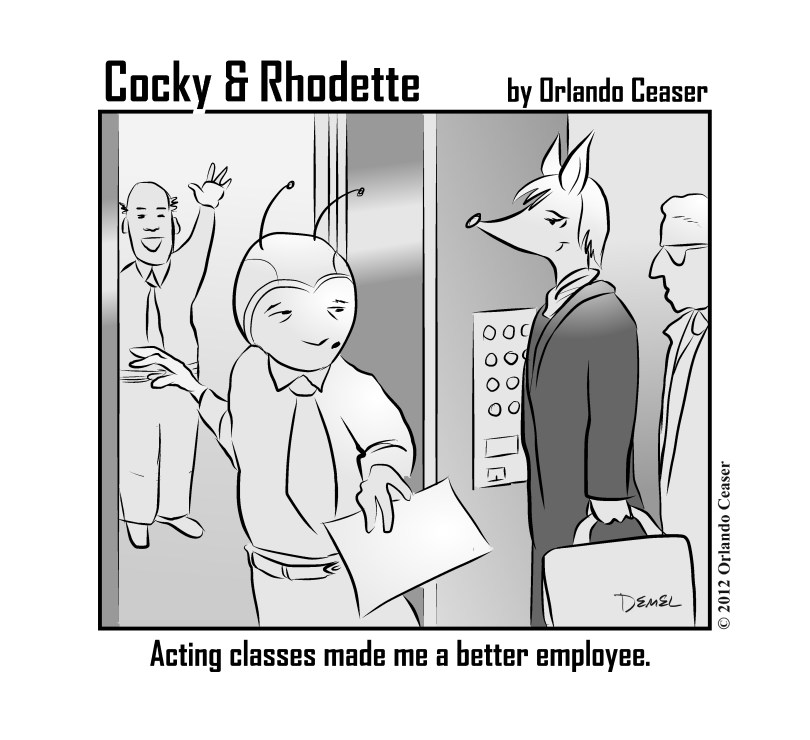
There are instances, where we assume certain traits and behaviors that initially feel awkward. They are not a natural part of who we are. We may be in the early stages of development. Therefore, we must fake it until we make it or act as if we have the skills, until they become a part of us.
When someone consistently plays a role, we can anticipate their actions and this predictability draws us into their character. This reminds me of us. We are vulnerable and share our personalities, so others can anticipate our actions. This predictability builds comfort, awareness and trust.
I was a part of a drama team at church, where we were trained by degreed professionals and practitioners, in the art of the theater. My manager questioned my hobby. I remember thinking, “you are asking me to act day at work, and least I can get some training to do it better.”
We are asked to act and play a role or different roles every day. We should at least play them with authenticity and transparency, until they are natural, realistic and believable.
In our role as leaders, there instances where we must act as a leader, until we put on the full mantle of the mindset and the role.
Through the practice of mental rehearsal, visualize an upcoming important conversation. Anticipate the worst possible outcome and how you will handle it.
Repeat step one several time to become comfortable with a range of response.
Role-play your goals with someone and give them permission to ask questions.
Conduct a mock interview and take turns being the applicant and the interviewer.
Read Michael Shurtleff’s book Audition to learn how actors prepare.
Read information on storytelling, public speaking and acting principles to improve your speaking and conversational skills.






 Leadership for the Soul